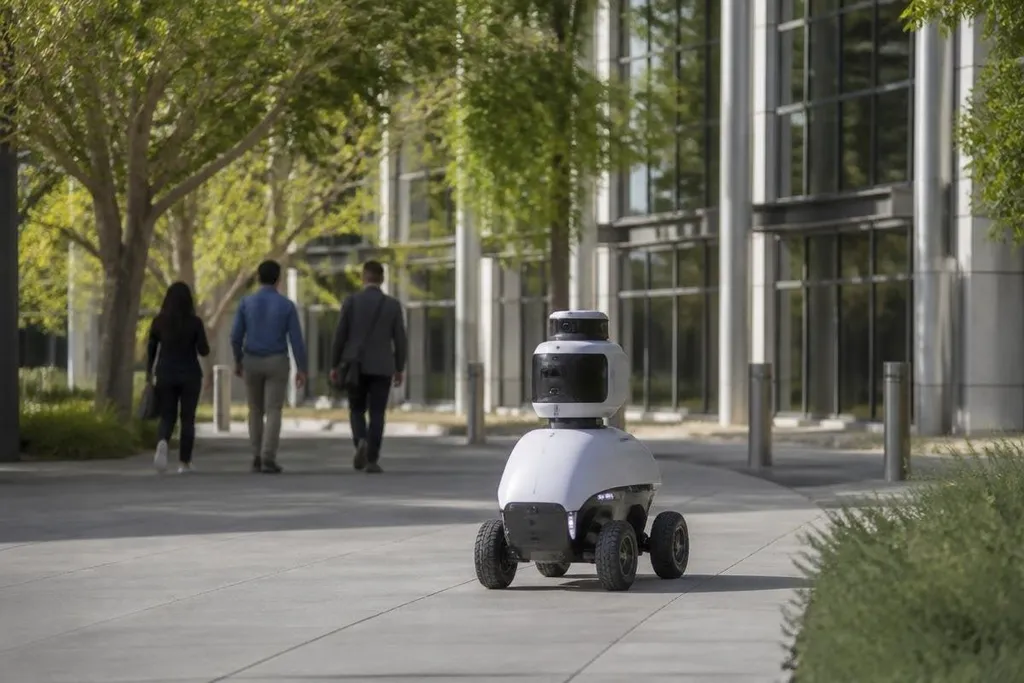
A security robot can watch a walkway for hours, send an alert, and let a remote operator check what its cameras see. That could help staff cover large public spaces, but the robot’s limits matter as much as its sensors.
- Robots can spot hazards, guide people, and report unusual activity.
- A remote operator still needs to check serious alerts.
- Clear rules should cover recording, access, movement, and failure.
What a security robot can do
The basic job is repeated observation. A robot can move through a set route, use cameras to inspect its surroundings, and send video or other sensor data to a control room.
If it detects smoke, a fallen person, an open gate, or an object left in a walkway, staff can decide what to do next.
That division matters. The robot handles the repeated patrol, while a person checks the meaning of an alert. A dark coat on the ground may be a bag, a person who needs help, or a harmless object that moved in the wind. Software can flag the scene, but context still needs a human decision.
Some systems may also use microphones, thermal cameras, LiDAR, or access-control links. Each tool has a narrow job. LiDAR measures distance with laser pulses, while a thermal camera shows heat rather than normal color. Adding sensors can give staff more information, but it also creates more data to store and protect.
Where the machine helps
Public spaces often include long corridors, parking areas, transit platforms, and building entrances. It can repeat the same route at night or during quiet periods, when sending a person to watch every area would be difficult.
It can also act as a moving help point. A screen or speaker could direct someone to an exit, connect them to staff, or report a blocked route. That role needs careful design because a person in distress may need a trained responder, not a screen giving fixed instructions.
For a robotics company weighing a public-space security robot, the useful record starts with the site, task, operator, and failure cases, not a smooth demo. Dated security robot field reports can connect those details to the machine’s job, so the next question is what happens when it loses a clear view or contact with staff.
Where the robot fails
A public space changes from minute to minute. Crowds block cameras, rain affects sensors, bright glass creates reflections, and a robot may stop when its route is blocked. A system that works on an empty floor can behave differently when people gather around it.
Movement creates another risk. The robot needs a safe speed, a clear stop rule, and a way to give people space. Its emergency stop should be easy for staff to reach, and its software should record when the stop was used. If it cannot move safely, the robot should wait for help rather than force its way through a crowd.
Privacy needs a separate rule set. Operators should know what the cameras record, how long the files stay available, and who can view them. Facial recognition would raise a different set of legal and public concerns from a camera that only detects an obstacle, so the system’s exact features need to be stated before use.
The open issue is proof. A vendor may show a robot finding a person or object in a controlled video, but that does not show how often it raises false alerts in a busy station. I’d judge a security robot by its alert record and failure handling, not by a smooth patrol video.
A buying and policy checklist
Before a public-space operator approves a trial, check these points:
- Define the patrol route, speed limits, and areas the robot must avoid.
- Set a named human team for alerts, maintenance, and emergency stops.
- Record what each sensor collects and when the system deletes it.
- Test rain, crowds, blocked routes, poor lighting, and lost network access.
- Measure false alerts, missed events, response time, and stopped patrols.
- Publish a plain notice that tells people what the robot does.
A trial should finish with a written result, not a video. The useful numbers are the hours patrolled, alerts checked by staff, false alerts, missed events, repair time, and any complaint about privacy or access.
Security robots could help cover public spaces, but their value depends on the people and rules around them. The next serious test is simple: can a site show fewer missed hazards without collecting more personal data than its staff can justify?